IMG_2625_1920x1275
Service

OUR SERVICES

CONSULTInG/ADVISORY

We provide consulting and advisory services with specializations in applied research and digital transformation, particularly in the areas of healthcare, environment and the arts/digital media. Our framework for digital adoption/transformation consulting/advisory builds on the individual experiences of our team, with the aim of cross-leveraging for new interdisciplinary projects.

CAPACITY BUILDING

We conceptualize, design, team-build, launch and or manage STEM/STEAM capacity building programs with partners in industry, community, non-profit, academia and government. Our goal is to narrow the digital divide between tech-related opportunities and marginalized groups through innovative, diverse and inclusive programs in education, training and upskilling

C4G ProJECTS

Interdisciplinary Computing for Good project development round out our services. We build the partnerships for impact programs and innovation projects. We take on leadership and delivery roles from ideation & strategy, partnership development to final delivery & evaluation, including funding (government, foundations, industry).  Making it happen.

PROJECTS

EDS_500x500

EARTH DATA STORE & ANALYTICS
An interdisciplinary $1.6M 3-year project based at the University of Victoria with the National Research Council Digital Health and Geospatial Analytics Program.
mocap-dance-combo_500x500

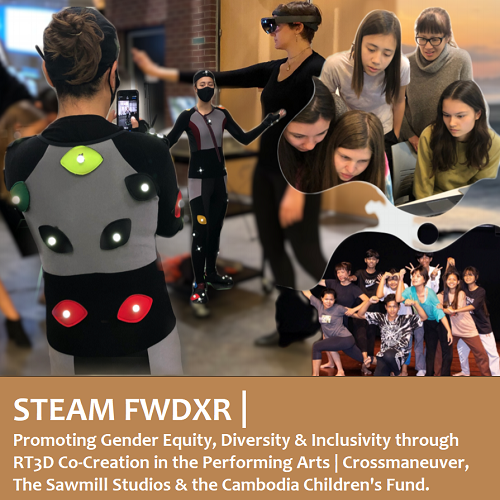
STEAM, DaNCE & RT3D
Addressing the digital divide with remote paired learning to teach the teacher in creative and technical skills for hybrid performances. 
Youth_500x500

MENTAL HEALTH & YOUTH
Seeking to build resiliency and mental/cognitive well-being among youth and students in response to the Covid-19 pandemic.

EDUCATION | Strategic Initiative Spotlight

CAPACITY BUILDING FOR DIGITAL TRANSFORMATION

The PCCA mission to support capacity for digital programs has led to the formation of an initiative aimed at empowering youth or individuals that are training to master digital technologies and skills at various levels including K-12, post-secondary and professional. Currently, PCCA is evolving a STEAM learning model that aims to assist in the fostering of digital skills across disciplines and sectors, as well as digital transformation in education, through paired-learning, options for remote or hybrid learning, industry-academic-community cooperation, and social/environmental impact or interdisciplinary computing-4-good (C4G) projects. Sustainability, diversity and resiliency are key themes for next gen mindset and skills. 

Building on its collaborative applied research and work-integrated learning projects, PCCA recently launched two micro-credentials: (i) Culturally-Aware AI in Indigenous Knowledge & Rights; and (ii) Community-Driven Citizen Science for Earth Observation Data - both in support of the United Nations Sustainable Development Goals (UN SDGs). These programs are being developed in cooperation with the University of Victoria, CIFAL Victoria, the United Nations Institute for Training and Research (UNITAR) and community & industry partners; They also leverage research collaboration in cloud computing, initially for applications using Large Language Models (LLMs), AI, geospatial data and then broadening to include other types of data store including real-time 3D. PCCA is also working on expanding its STEAM work-integrated learning projects with the School of Interactive Arts & Technology at Simon Fraser University in the Metro Vancouver Regional District.  Support for the hardware and cloud resources, including within a digital sandbox of advanced technology pipelines for interdisciplinary work-integrated learning, is also key in the PCCA's capacity building model for digital transformation.

To join the PCCA EDUCATION list, please email info@coastalcomputing.ca. This email is low noise, and is where new programs/projects and requests for partners will be announced. 

EARTH DATA STORE (EDS)

This initiative builds on the ongoing Earth Data Store (EDS) project supported by the Digital Supercluster and other partners. The EDS has an emphasis on geospatial data, but in reality, the parameters for the projects themselves are flexible enough to accommodate most student interests. As part of the work on the EDS project, we have developed tools and techniques for use on the Microsoft Azure platform for storing geospatial data, where the underlying techniques can apply to any cloud platform.

PAIRED LEARNING | STUDENTS

The initiative is designed as a paired learning experience. In previous summers, students from the VERNA J. KIRKNESS EDUCATION FOUNDATION program visited the Coady Lab at the University of Victoria. The program addresses the under-representation of First Nations, Métis and Inuit students at Canadian universities. With scholarship funding, these high school students were visiting for a couple of weeks to get a taste of university life in an engineering program. The pairing with university students in the lab was a fruitful and exciting learning experience on both sides. In this new age of potentially-reduced social interaction, it is wise to consider what elements of a paired experience would apply to remote collaboration.

PAIRED LEARNING | PROFESSIONALS

As a paired learning experience, the target of this program is not (just) high school and post-secondary students. The goal is to develop cloud computing competency at a local level to enable development of the technological capacity to securely create, manage, backup, and control access to cloud computing applications and data sources. The implicit goal is to share the tools to enable a true data sovereignty built on top of commercial cloud services. As such, a mid-career professional looking to add a new competency is a great candidate for the program. The specific project will be jointly-designed, and to be conducted as hybrid or remote work. This synergy of pairing students and industry professionals benefits both.

Working with Academic Institutions and Academic-Industry/Community Partnerships | Overhead & Administrative Fees: As a non-profit, PCCA's mandate is to ensure the maximum possible value of the financial contributions made to PCCA partnerships/projects/programs go directly to benefiting the students and communities we serve, and or the education and applied research initiatives we participate in or support. As such, our policy is to uphold a zero percentage administrative overhead on outgoing financial contributions including to educational institutions.